
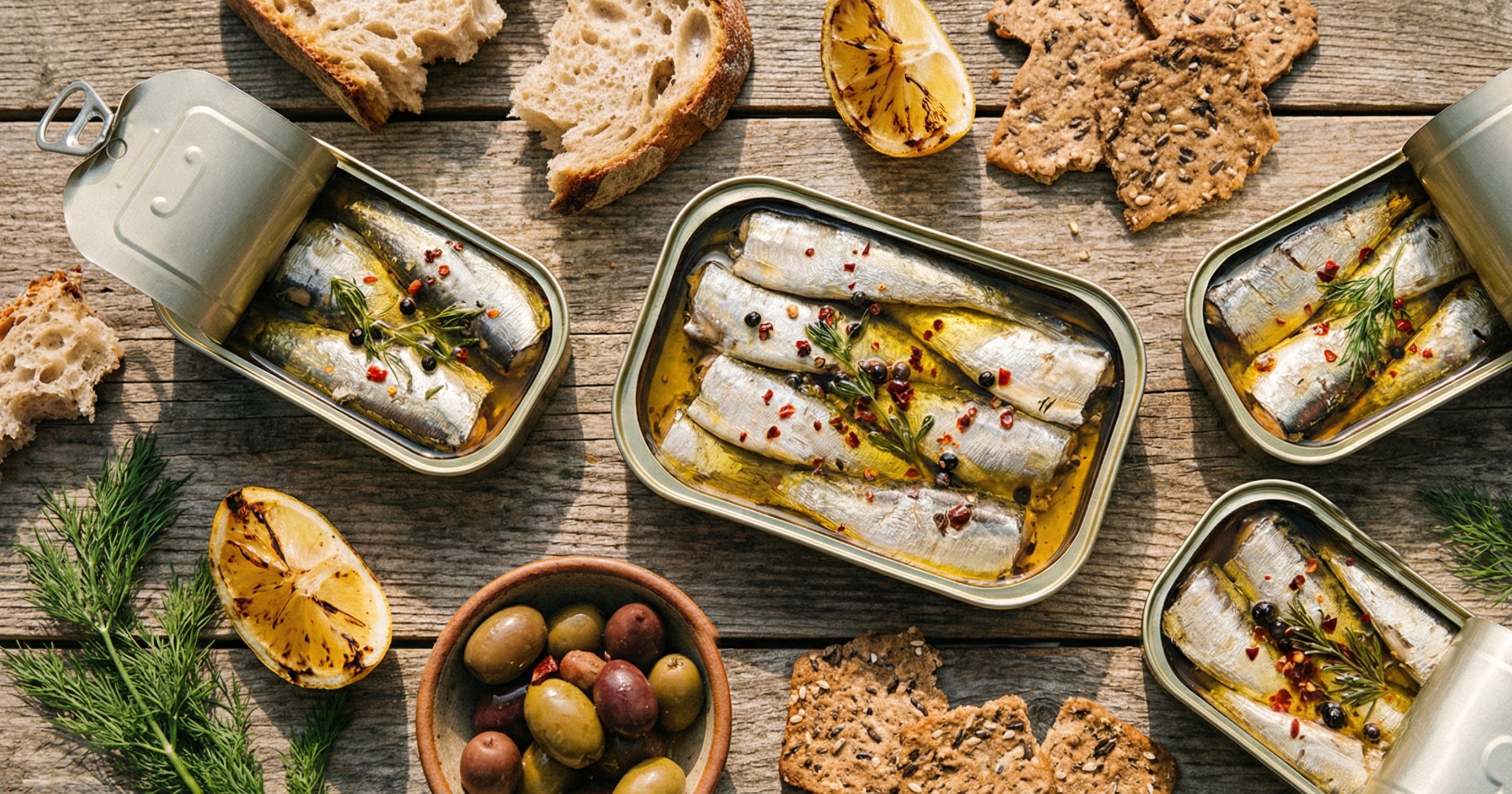
The "Cardiologist in a Can":
Lipid Remodeling with Marine Omega-3s.
Why the humble sardine and mackerel may be more effective for high triglycerides than many supplements—if you choose the right ones.
Busting the "Processed" Myth
We often assume fresh is best, but when it comes to Omega-3s, the canning process is a secret weapon. The high heat used to seal cans (retorting) happens in a vacuum (no oxygen). This locks in delicate fatty acids better than frying fresh fish in an open pan, where air and heat destroy the nutrients.
How It Works: The "Docking Station" Effect
Your liver uses LDL Receptors (docking stations) to grab bad cholesterol from the blood and clear it. A protein called Idol acts like a saboteur, destroying these stations.
The Fix: The DHA in canned fish blocks the saboteur. This keeps your docking stations open, allowing your liver to clear LDL naturally.
The Safety Matrix: Omega-3 vs. Mercury
We rank species based on the "Safety Surplus"—the ratio of Selenium (which neutralizes mercury) to Omega-3 density.
| Tier | Fish Species | The Superpower | Therapeutic Verdict |
|---|---|---|---|
| S | Atlantic Mackerel (Not King Mackerel) |
Highest Potency (~2.5g Omega-3) | The Gold Standard |
| S | Sockeye Salmon | Astaxanthin (Antioxidant) | Best Protection |
| A | Sardines (in EVOO) | Zero Mercury / High Calcium | Daily Driver |
| B | Light Tuna / Skipjack | High Protein | Good (Low Omega-3s) |
| F | King Mackerel | High Methylmercury | DO NOT EAT |
The "Every-Other-Day" Protocol
The goal is to average ~1.5g of Omega-3s per day without burnout. We rotate species to maximize nutrient diversity.
Monday: The Heavy Lifter
Menu
1 Can Atlantic Mackerel
Ideally packed in olive oil.
~2.5g Omega-3s
Why: Front-loads your week with a massive therapeutic dose. Mackerel has the highest Omega-3 density of any canned fish.
Tip: Mash with avocado and lemon on toast.
Wednesday: The Antioxidant
Menu
1 Can Sockeye Salmon
Bone-in / Skin-on preferred.
~1.2g Omega-3s
Why: Sockeye feeds on krill, giving it deep red flesh full of Astaxanthin, which protects the fats from oxidizing in your body.
Tip: Flake into a salad or mix with Greek yogurt for a dip.
Friday: The Nutrient Bomb
Menu
1 Can Sardines
In Extra Virgin Olive Oil.
~1.5g Omega-3s
Why: Because you eat the whole fish (bones and organs), you get a massive dose of Calcium and Vitamin D along with the healthy fats.
Tip: Sauté with garlic, chili flakes, and pasta ("Pasta con le Sarde").
🛒 The Buyer’s Checklist
The "Atlantic" Rule
Always check the label for "North Atlantic" Mackerel (Scomber scombrus). Never buy generic "Mackerel" or "King Mackerel," which are predator fish with high mercury levels.
The Oil Test
Buy: Fish packed in Extra Virgin Olive Oil (EVOO).
Avoid: Sunflower, Soybean, or "Vegetable" oil (High Omega-6s).
The "Full Can" Rule: If you buy fish in EVOO, do not drain the can! Up to 30% of the Omega-3s migrate into the oil. Pour the oil over your food—it's part of the dose.
The BPA Check
Look for "BPA-NI" (Non-Intent) on the can. BPA is an endocrine disruptor that can interfere with metabolic health.
Approved Brands
Specific brands verified for quality and safety.
Organic Extra Virgin Olive Oil. Skinless & Boneless.
Olive Oil. Skinless & Boneless. Wild Caught.
Water packed (Low Calorie). No Salt Added. Low Mercury.
Olive Oil. Skinless & Boneless.
Skinless & Boneless. 100% Sustainable.
Pouch format. Skinless/Boneless. Mercury Tested.
Traditional Style.
EVOO. Lightly Smoked. Sustainably Caught.
Spanish Gourmet. Packed in high-quality Olive Oil.
Organic Extra Virgin Olive Oil.
Lemon Olive Oil or Roasted Garlic.
View Scientific Sources ▼
1. Zelber-Sagi, S., et al. (2015). "Idol-dependent LDL receptor degradation." Journal of Lipid Research.
2. Harris, W. S. (1997). "n-3 fatty acids and serum lipoproteins: human studies." American Journal of Clinical Nutrition.
3. Burger, J., et al. (2012). "Selenium:mercury molar ratios in freshwater fish." Science of The Total Environment.
4. Dantas, N. M., et al. (2021). "Cholesterol oxidation products in canned tuna: Impact of packing medium." Food Chemistry.
5. FDA (2020). "Mercury Levels in Commercial Fish and Shellfish." U.S. Food and Drug Administration.