
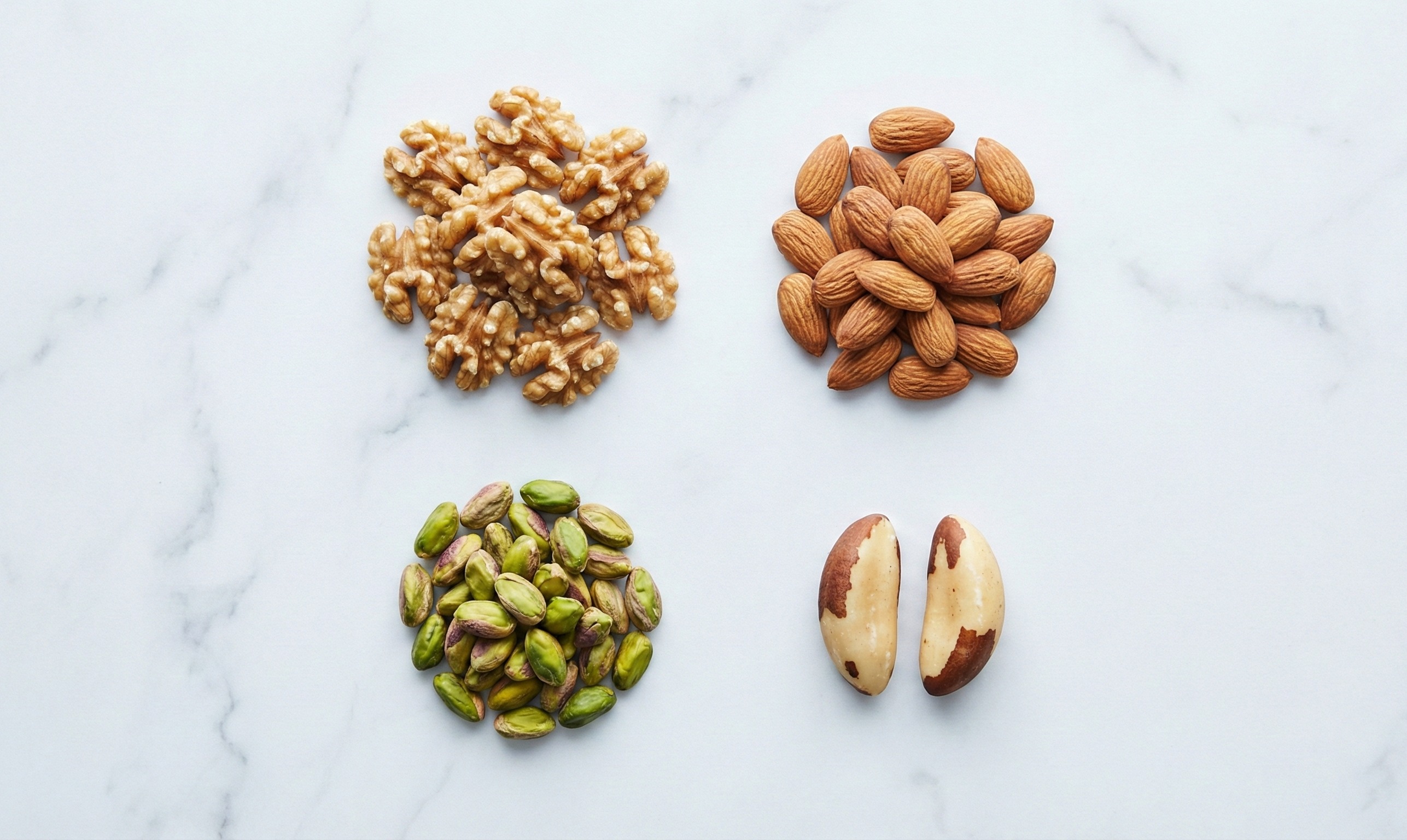
Not All Nuts Are Created Equal:
Matching the Nut to the Lipid Profile.
New research confirms that walnuts, almonds, and pistachios affect cholesterol through completely different biological mechanisms.
The "Matrix Effect"
It’s not just about fat content. We now know that the Food Matrix—the physical structure of the cell walls, combined with fiber, phytosterols, and antioxidants—is what drives lipid modulation.
1. Walnuts
The LDL Remodeler
Walnuts are the only tree nut primarily composed of polyunsaturated fats (ALA Omega-3). While most nuts simply lower total cholesterol numbers, walnuts actually change the shape of your cholesterol particles.
Mechanism of Action
Particle Remodeling: The WAHA Trial found that walnuts reduce the number of Small, Dense LDL particles by 6.1%.
Why this matters: Small particles penetrate arterial walls easily. Walnuts promote larger, "fluffy" particles that are less dangerous.
The Protocol
- 🎯 Target: Metabolic syndrome / Small LDL.
- ⚖️ Dose: 30–60g (14–20 halves).
2. Almonds
The Volume Reducer
If Walnuts are the architect, Almonds are the demolition crew. Rich in fiber and Monounsaturated Fats, their primary function is bulk reduction of LDL-C and ApoB.
Mechanism of Action
Bile Acid Sequestration: The fiber in almonds binds to bile acids, forcing the liver to pull LDL cholesterol from the blood to create more.
ApoB Reduction: Clinical trials show a dose-dependent reduction in Apolipoprotein B (the plaque backbone).
The Protocol
- 🎯 Target: High Total LDL / High ApoB.
- ⚖️ Dose: 42g per day (approx. 35 nuts).
3. Pistachios
The Metabolic Reset
Pistachios are green for a reason: Lutein. They are the most effective nut for lowering Triglycerides and managing glycemic response.
Mechanism of Action
Triglyceride Clearance: Meta-analyses show pistachios reduce Triglycerides by ~11 mg/dL, superior to other nuts.
Oxidation Defense: The Lutein prevents LDL from oxidizing (rusting).
The Protocol
- 🎯 Target: High Triglycerides / Pre-diabetic.
- ⚖️ Dose: 42g per day.
4. Brazil Nuts
The Specialist
Warning: Brazil nuts are potent. Treating them like a snack can lead to Selenium Toxicity. Treat them like a supplement.
Their primary value is their massive density of Selenium, a mineral required to activate the body's master antioxidant enzyme (GPx).
Mechanism of Action
Systemic Defense: Eating just one nut saturates GPx activity, neutralizing oxidative stress system-wide.
The Protocol
- 🎯 Target: Oxidative Stress / Thyroid.
- ⚖️ Dose: 1 Nut Per Day Maximum.
At a Glance
| Nut Variety | Superpower | Primary Target | Daily Dose |
|---|---|---|---|
| Walnuts | Omega-3 (ALA) | Particle Size | 14 Halves |
| Almonds | Fiber & Vit E | Total LDL / ApoB | 35 Nuts |
| Pistachios | Lutein | Triglycerides | 49 (In Shell) |
| Brazil Nuts | Selenium | Oxidative Stress | 1 Nut Only |
Shop The Protocol
The specific brands I use to ensure purity.
NOW Foods Organic Walnuts
Raw & Unsalted. Crucial because roasting damages delicate Omega-3 fats. Certified organic ensures no pesticide residue.
Shop on Amazon ➔Daily Crunch Almonds
Sprouted. The sprouting process removes phytic acid, making the nutrients more bioavailable and easy to digest.
Shop on Amazon ➔Wonderful Pistachios
No Shells. While shells slow you down, these "No Shell" packs are essential for easy meal prep (great for salads).
Shop on Amazon ➔Terrasoul Brazil Nuts
The Supplement. High-potency. Remember the protocol: Eat only ONE per day to optimize selenium without toxicity.
Shop on Amazon ➔View Scientific Sources ▼
1. Rajaram, S., et al. (2021). Effects of Walnut Consumption for 2 Years on Lipoprotein Subclasses Among Healthy Elders: The WAHA Randomized Controlled Trial. Circulation.
2. Berryman, C. E., et al. (2015). Dose-response of almonds on coronary heart disease risk factors... a randomized controlled crossover trial. American Journal of Clinical Nutrition.
3. Muley, A., et al. (2021). Consumption of pistachio nuts positively affects lipid profiles: A systematic review and meta-analysis. Critical Reviews in Food Science and Nutrition.
4. Colpo, E., et al. (2013). A Single Consumption of High Amounts of the Brazil Nuts Improves Lipid Profile of Healthy Volunteers. Journal of Nutrition and Metabolism.
5. Guasch-Ferré, M., et al. (2018). Effects of walnut consumption on blood lipids and other cardiovascular risk factors: an updated meta-analysis. American Journal of Clinical Nutrition.